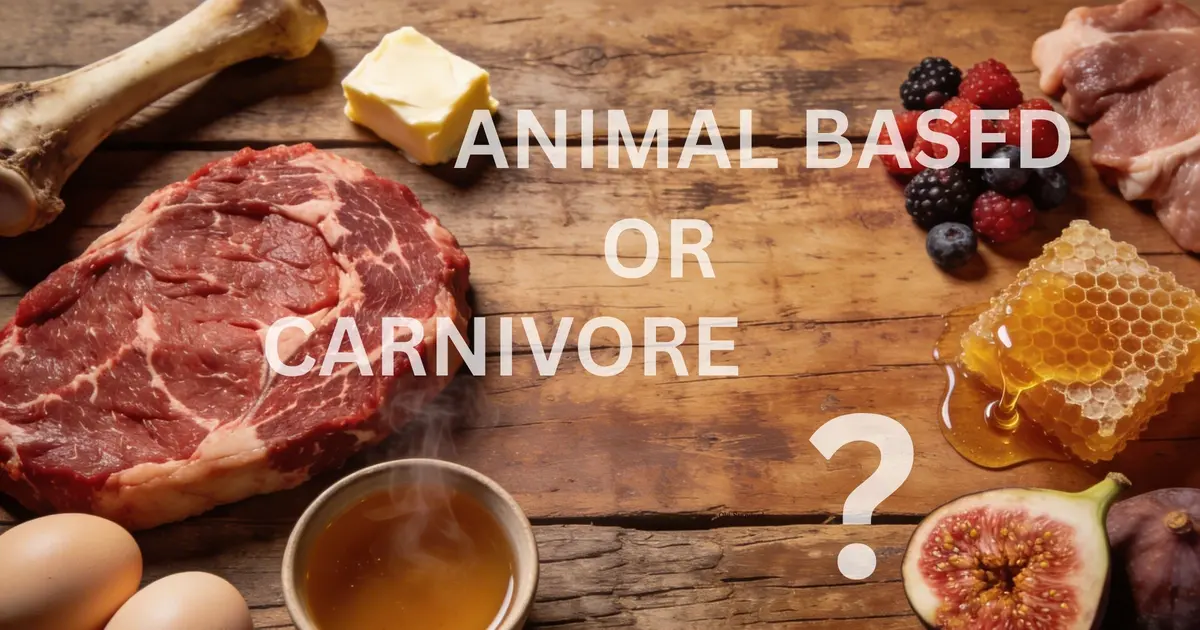
If you've spent any time in carnivore or ancestral health communities recently, you've noticed something: the conversation has split. There's carnivore — meat, fish, eggs, and dairy, all animal foods, nothing from the plant kingdom — and there's "animal-based," which shares that animal-food foundation but adds fruit and honey as acceptable carbohydrate sources. Within carnivore itself, there's also the lion diet at the strictest end: beef, salt, water only.
Both are increasingly popular. Both have vocal advocates. And if you spend enough time in either community, you'll encounter people who treat the other approach with deep suspicion.
This article isn't going to take sides. What it will do is explain both approaches clearly, describe what tracking looks like for each, and make the case for why your own data is ultimately more useful than anyone else's rules.
Carnivore: What It Actually Means
The carnivore diet in its strictest form is exactly what it sounds like: eat only animal-sourced foods. Meat, fish, eggs, animal fats. Nothing from the plant kingdom. No fruit, no vegetables, no grains, no legumes, no nuts, no seeds, no plant-based oils.
In practice, most people following a carnivore approach exist on a spectrum:
Strict or "lion diet" carnivore: Beef, salt, water only. Sometimes eggs included. This is the most restrictive version, used primarily as a short-term elimination baseline or by people with severe food sensitivities who need the cleanest possible starting point.
Standard carnivore: All meats, fish, eggs, animal fats. Salt. Some practitioners include dairy; others exclude it during an initial elimination phase and reintroduce it systematically.
Nose-to-tail carnivore: Emphasis on organ meats — liver, heart, kidney, bone marrow — as nutritional cornerstones alongside muscle meat. Often called the most nutrient-dense version of the diet.
Ketovore / keto-carnivore: Primarily animal foods, but carbohydrates are tracked and kept low rather than eliminated entirely. May include some low-carb plant foods. The crossover between strict keto and carnivore.
What unites all versions: the removal of plant foods as the primary dietary change, and the reliance on animal proteins and fats as the nutritional foundation.
Animal-Based: What It Actually Means
"Animal-based" emerged primarily through the work of Dr. Paul Saladino, who popularised the concept of building a diet around animal foods while incorporating certain plant foods — specifically fruit, honey, and raw dairy — that are lower in plant defence compounds (lectins, oxalates, phytates) than most plant foods.
The core logic: if the concern with plant foods is their antinutrient content and potential inflammatory effects, then some plant foods are more problematic than others. Fruit is lower in lectins than grains. Honey is simpler in its sugar composition than processed sweeteners. Raw dairy preserves enzymes that are destroyed by pasteurisation.
What animal-based typically includes:
- Muscle meat and organs (similar to carnivore)
- Fruit — particularly tropical fruits and berries
- Raw honey
- Raw dairy (raw milk, raw cheese, raw butter) — emphasised over pasteurised
- Eggs
- Animal fats
What animal-based typically excludes or minimises:
- Grains, legumes, and seed oils (consistent with carnivore)
- Vegetables high in oxalates or lectins (spinach, kale, nuts, seeds)
- Processed foods
The difference from strict carnivore is the inclusion of low-toxicity plant foods — primarily fruit and honey — as carbohydrate sources, alongside a strong emphasis on organ meats and raw animal products.
Where the Communities Collide
The friction between carnivore and animal-based communities usually comes down to two questions: whether fruit raises insulin in a problematic way, and whether "no plants" is a necessary rule or an unnecessarily strict elimination.
Strict carnivore advocates argue that any plant food carries risk for sensitive individuals, that carbohydrates from fruit are metabolically unnecessary, and that the strictest elimination produces the cleanest data.
Animal-based advocates argue that whole fruit is not metabolically equivalent to processed sugar, that certain nutrients in fruit and raw honey complement an animal-food diet, and that rigid rules remove foods that many people tolerate well.
Both positions have genuine arguments behind them. And here's the thing: for any given individual, only their own body's data can settle the question. There is no universal answer. The person who thrives on fruit alongside their animal foods is not wrong. The person for whom fruit derails their inflammatory symptoms is not wrong either. They're just different bodies with different responses.
This is precisely why tracking matters more than doctrine.
What Tracking Looks Like for Each Approach
Tracking Strict Carnivore
Strict carnivore tracking is in some ways the simplest version — the food variables are minimal, which makes pattern detection cleaner. The main tracking dimensions:
Food detail that matters:
- Protein source and cut (important — different proteins have different effects for sensitive individuals)
- Fat content and type (grass-fed vs. grain-fed, rendered tallow vs. butter, fatty cuts vs. lean)
- Histamine load (fresh vs. aged, raw vs. slow-cooked — histamine increases with storage and cooking time; relevant for people with histamine intolerance)
- Organ meat frequency (liver has distinct effects on energy and skin for many people)
- Dairy inclusion or exclusion
Symptoms to watch: Energy, skin, gut, cognitive clarity, joint stiffness, sleep quality. With strict carnivore, the food variable space is narrow enough that symptoms correlate more clearly to specific protein choices — which is the point of the strict approach.
Tracking Animal-Based
Animal-based tracking has more variables, which makes the data richer but the patterns slightly harder to isolate:
Additional food variables vs. strict carnivore:
- Fruit type and quantity (fructose load varies significantly — a few berries versus a large fruit salad are different metabolic events)
- Honey quantity and timing (raw honey affects blood glucose differently than no carbohydrate)
- Raw vs. pasteurised dairy (different enzyme profiles, different protein structures)
The value of tracking for animal-based specifically: Many people transition to animal-based from strict carnivore because they want to reintroduce some plant foods. Without tracking, the reintroduction is guesswork. With tracking, you build the data to know exactly how your body responds to fruit, to honey, to raw dairy — individually and in combination.
If your skin improves on strict carnivore but you want to reintroduce mango — track it. Eat it for two weeks. Log your skin condition, your energy, your gut every day. The data tells you whether mango is a problem for you. That answer belongs to you, not to either community's doctrine.
Both Approaches Work Better With the Same Tracking Framework
Regardless of where you sit on the carnivore-to-animal-based spectrum, the tracking structure is identical:
Daily logs:
- Every food consumed, with protein source, cut, quantity, and cooking method
- Symptom severity for your primary concern (skin, gut, energy, cognitive, joint) rated 1–10
- Energy levels morning, midday, evening
- Sleep quality and hours
- Stress level
- Any unusual exposures or variables
The delay window: Log every day and let the data bridge the gap between what you ate and when your body responded. Whether you're on strict carnivore or animal-based, the delayed reaction window is the same — and it's the gap that makes food-symptom connections invisible to unaided observation.
Reintroduction data: If you're using an animal-based approach to systematically reintroduce foods after a carnivore baseline, your daily logs during reintroduction are your most valuable data. One food at a time, 1–2 weeks of consistent exposure, daily symptom logging throughout.
The Only Rule Worth Following
Both the carnivore and animal-based communities have something right and something slightly incomplete. Strict carnivore is right that a clean elimination baseline produces the clearest data. Animal-based is right that individual responses to plant foods vary enormously and that rules shouldn't be applied universally.
The resolution isn't a philosophical position. It's data.
Start with the cleanest baseline you can manage. Build enough consistent data to see patterns. Then test foods systematically and let your body's response — logged, timestamped, and reviewed across the appropriate lag window — tell you what works for your unique physiology.
That answer will not be identical to Kristina's. Or Paul Saladino's. Or your carnivore Reddit community's. It will be yours.
Disclaimer: This article is for informational purposes only and does not constitute medical or nutritional advice. Always consult a qualified healthcare professional before making significant dietary changes, particularly if you are managing a diagnosed medical condition or taking prescribed medication. References to specific dietary approaches represent common community practices and not medical recommendations.