You've committed to carnivore — or you're seriously considering it. You want to track your food, your symptoms, your progress. You open the App Store, search "carnivore diet tracker," and find a wall of options that all look vaguely similar. Macro counters. Meal loggers. Fasting timers. None of them seem quite built for the specific thing you're trying to do.
This comparison cuts through it. We've looked at every major carnivore tracking option available in 2026, assessed what each one actually does well, and — because we think you deserve honesty, not just marketing copy — told you what each one is missing.
One caveat up front: Carnivore Lifestyles is one of the apps in this comparison, and it's our product. We've tried to represent the others fairly. Read the breakdown and decide for yourself.
What Actually Matters in a Carnivore Tracking App
Before comparing apps, it's worth being clear about what matters — and what's noise.
Most tracking apps were built to count calories and macros across a general diet. When they add "carnivore mode" it's usually a filter on top of a system that assumes you eat grains, vegetables, and packaged foods. That creates friction: you search "ribeye," you get ribeye-flavoured crisps, seasoning packets, and a dozen restaurant entries. You spend more time searching than eating.
Beyond the food logging problem, carnivore tracking has two specific needs that generic apps rarely serve:
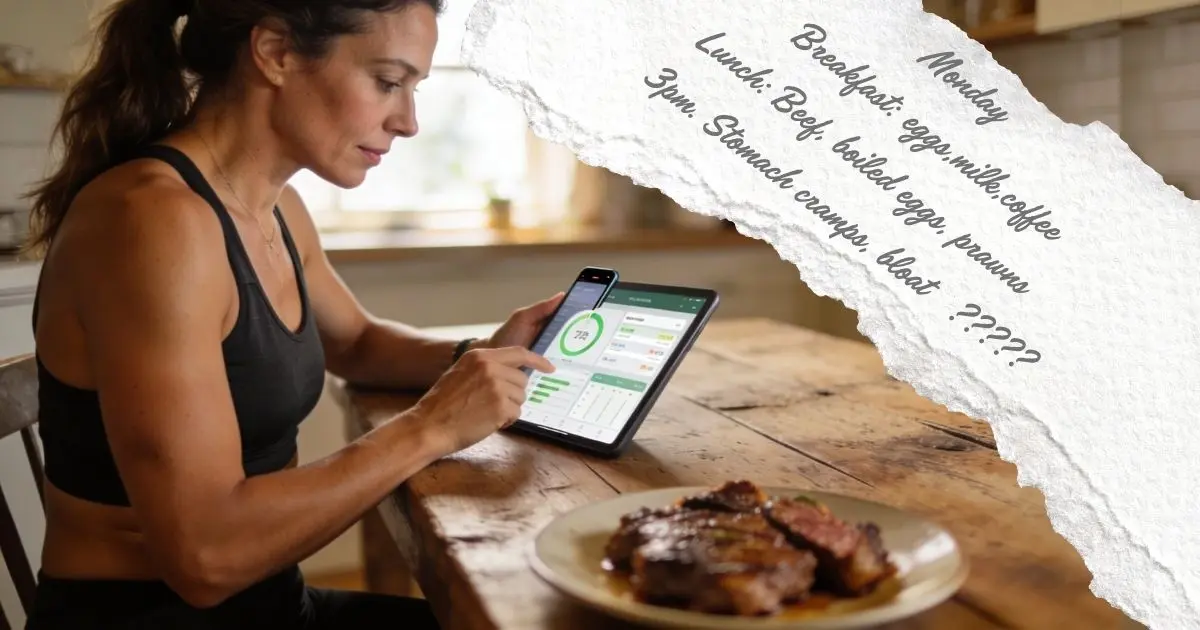
Symptom tracking alongside food. The reason many people go carnivore in the first place — reversing chronic inflammation, identifying food sensitivities, clearing skin conditions, resolving gut issues — requires connecting what you ate to how you felt, days later. That's not macro counting. That's pattern detection across a complex timeline.
Delayed reaction tracking. Food sensitivities frequently show up 3–7 days after the trigger food was eaten, not hours later. Unless your app logs symptoms with timestamps and connects them to meals across a multi-day window, you're missing the most important data point in your elimination process.
Most apps on this list don't address either of these. That's not a criticism — they're built for different goals. But if your goal is health recovery through a carnivore or animal-based approach, it matters.
Here's the full breakdown:
The Apps
Carnivore Lifestyles (carnivoretracker.app)
Best for: Anyone using carnivore or animal-based eating to address health symptoms — autoimmune conditions, food sensitivities, chronic inflammation, skin, gut, or energy issues. Also the only option that tracks both humans and pets under one account.
What it does: Carnivore Lifestyles is a web-based app built specifically for symptom-aware tracking. It logs meals, symptoms, health metrics, lifestyle factors, and medications — and its AI pattern analysis (which activates at day 45 of consistent logging) looks for connections between food and symptoms, including delayed reactions that appear 3–7 days after eating. The app is fully diet-agnostic: it tracks whatever you eat — meat-heavy, animal-based, carnivore-with-fruit, or anything in between — with no judgment and no restrictions on what can be logged.
The multi-profile system is unique in the market: one account covers multiple household members, including pets. If you're running a carnivore elimination for yourself and a food sensitivity investigation for your dog simultaneously — which more people do than you'd expect — this is currently the only tool built for that.
A built-in community with moderated groups and private chats is available from day one — no need to reach a usage threshold or pay extra to access peer support.
Pricing: 14-day free trial (no credit card required), then $12.99/month.
What it doesn't do yet: Currently web-based only — accessible from any device browser, but no dedicated iOS or Android app at this stage (native iOS and Android apps are next on the roadmap — the decision to launch web-first was intentional, keeping development lean while new features ship quickly). No barcode scanner or photo-logging of food; it's designed for deliberate, ingredient-level logging rather than quick macro capture. Not the right tool if your primary goal is fast macro counting for body composition.
Privacy: GDPR-compliant EU servers. Data is encrypted; administrators cannot read personal entries. Data is never sold to third parties. Optional anonymised research opt-in.
Vore
Best for: Carnivore dieters whose primary goal is meal planning and macro tracking, particularly those who want ready-made meal plans and AI photo logging.
What it does: Vore is arguably the most polished dedicated carnivore macro tracker available in 2026. It has 15 pre-built weekly carnivore meal plans (including nose-to-tail, budget ground beef, and lion diet variants), AI photo logging (snap a plate, macros are estimated automatically), a barcode scanner, restaurant menu scanning, and a clean protein-to-fat ratio dashboard. It claims 50,000+ users and has the most active development of any dedicated carnivore app.
What it doesn't do: No symptom tracking. No health metrics logging beyond weight and body measurements. No multi-user/family profiles. No delayed reaction detection. Vore is a meal planning and macro tool — an excellent one — but it won't help you understand why you felt terrible on Thursday if you're trying to trace it to Monday's food.
Pricing: Free with limitations; paid subscription for full meal plans and features.
Cartra
Best for: Carnivores who want a simple, meat-focused calorie and macro counter without the complexity of a general-diet app.
What it does: Cartra is a streamlined macro tracker designed specifically for carnivores. It has a meat-centric food database, calorie counter, macro calculator, and meal logging. The interface is cleaner than a general-diet app because it doesn't try to serve every dietary philosophy simultaneously.
What it doesn't do: Reviews note some reliability issues and a frustrating onboarding experience, including a weight-entry bug that's been reported by multiple users. No symptom tracking, no health metrics, no family profiles. The food scanning feature reportedly requires a subscription and has had functional issues. Good concept, but the execution needs work.
Pricing: Subscription required for core features including food scanning.
GoCarnivore
Best for: Carnivore beginners who want community, coaching, doctor access, and structured challenges more than a tracking tool.
What it does: GoCarnivore is primarily a community and coaching platform rather than a tracking app. It offers access to carnivore doctors and nutritionists, 90-day challenges, expert Q&As, recipes, and peer community. The tracking functionality is secondary. If you're newly starting carnivore and want human support and accountability, GoCarnivore's community is genuinely strong.
What it doesn't do: It's not primarily a data tool. Symptom tracking is not a focus. It runs on the Mighty Network platform, which means the experience is community-forum-first, not data-dashboard-first.
Pricing: Free community tier; paid premium for challenges, doctor access, and full resources.
Carnivore Diet App (carnivoredietapp.com)
Best for: Carnivore + fasting stackers who want a clean, simple logging experience.
What it does: A minimalist carnivore + fasting tracker. Simple meat-focused food log, fasting timer, weight and measurement tracking, progress charts. Designed for people who want to keep tracking simple — no feature bloat, quick daily logging. Works on iOS and Android.
What it doesn't do: Symptom tracking is absent. No health metrics beyond weight and body measurements. No meal planning. No family profiles. It's a clean, lightweight option for people whose primary focus is consistent food and fasting logging — not health investigation.
Pricing: Free tier available; premium for full features.
MyFitnessPal
Best for: People who want the largest food database in existence and don't mind doing carnivore tracking inside a general-diet tool.
What it does: MyFitnessPal has the biggest food database of any tracking app — over 14 million entries — extensive integration with wearables and health apps, a huge user community, and years of development. If you want to look up a specific cut of grass-fed beef from a specific retailer, it's probably in there.
What it doesn't do for carnivores: Almost everything about MyFitnessPal assumes a standard Western diet. Search results mix animal foods with steak-flavored snacks, restaurant entries, and processed products. The macro dashboard emphasises carbohydrates as a primary category — not ideal when your carb intake is zero. There's no symptom tracking, no health metrics beyond basic fitness logging, no family profiles, and no concept of delayed food reactions. It was not built for this use case and it shows. It remains a useful option if you're primarily interested in protein counting and already know your way around the app.
Pricing: Free with limitations; premium subscription for full features.
The Feature Gap Nobody Talks About
Every app in this comparison tracks food. Several track macros well. Some have strong meal planning. None of the others — except Carnivore Lifestyles — track symptoms and connect them to food over time.
This gap is consequential for a specific group of people: anyone using carnivore or animal-based eating as a health recovery approach rather than purely a body composition strategy.
If you're carnivore for weight loss and performance, macro tracking is probably sufficient. Vore or Cartra will serve you well.
If you're carnivore because you have psoriasis, eczema, IBS, joint pain, chronic fatigue, brain fog, recurring ear infections in your dog, or any condition you suspect is food-related — then tracking macros without tracking symptoms leaves out the data that would actually answer your question.
For people with food sensitivities, reactions often don't appear immediately after eating — they can surface days later, once a cumulative threshold is crossed. Your tracking system needs to cover that gap — logging what you ate and what you felt across a multi-week timeline — and then surface the patterns you can't see in real time.
That's a different tool for a different job. Both tools have their place. The key is knowing which one you need.
Which App Is Right for You?
Choose Vore if: Your primary goal is macro tracking, meal planning, and quick food logging. You're focused on body composition, performance, or just keeping your eating consistent. You want 15 ready-made carnivore meal plans and AI photo logging.
Choose GoCarnivore if: You're new to carnivore and want human community, doctor access, and structured challenges more than a data tool.
Choose Carnivore Diet App if: You want the simplest possible carnivore + fasting logger with no feature bloat.
Choose MyFitnessPal if: You're already embedded in its ecosystem, you want the largest food database available, and you're willing to work around its non-carnivore-first design.
Choose Carnivore Lifestyles if: You're using carnivore or animal-based eating to address a health condition. You want to track symptoms alongside food and discover which foods are driving which reactions. You're managing your own health, your pet's, or both — one account covers the whole household. You value privacy and data ownership. And you want AI to find the patterns in your data that you can't see in real time.
Disclaimer: This article includes Carnivore Lifestyles, our own product, alongside competitor apps. We've aimed to represent each product accurately based on publicly available information. App features and pricing change over time — verify current details directly with each provider. This article is for informational purposes only and does not constitute medical or nutritional advice. Always consult a qualified healthcare professional before making significant dietary changes.